
Cellular energy, explained.
Dr. Bryan often talks about cellular energy. Here is a closer look at the research behind that discussion and the separate questions about clinical devices.
A study of a cell mechanism can explain biology without showing that a particular device helps patients. Read the methods, findings, and limits together.
Care begins with getting to know you.
Dr. Bryan Riecker, DC, brings a chiropractic perspective to joint and whole-body care. We review your history, discuss your goals, and use an evaluation to guide recommendations.
- Step 1
Time to listen
Your day-to-day experience belongs in the conversation, alongside your medical history.
- Step 2
A thoughtful evaluation
Relevant imaging, lab results, and an examination help put your concerns in context.
- Step 3
A plan you understand
We explain the options, their limits, and the cost so you can make an informed choice.
Some studies can tell you more.
How a study is designed decides how much it can tell you. When the question is whether a treatment works, these are the five kinds you will see below, from the earliest step to the strongest.
- 1
Lab study
Researchers test cells in a dish or measure what a product contains.
Can't tell youWhat happens inside a living person.
- 2
Animal study
Researchers create an injury in rats or rabbits and compare groups that get different treatments.
Can't tell youWhether the same thing happens in people.
- 3
Early human trial
A small group of patients gets the treatment so researchers can check safety and get a first look at benefit.
Can't tell youWhether a good result came from the treatment, from chance, or from the placebo effect.
- 4
Placebo trial
Patients are assigned by chance to the real treatment or a placebo, without knowing which. It's the fairest test of the treatment itself.
Can't tell youHow a different procedure or condition would turn out.
- 5
Systematic review
Researchers gather every study they can find on one question and look at the results together.
Can't tell youMore than the studies inside it. Weak studies make a weak review.
- Placebo
- A fake version of a treatment. People who get a placebo often improve too, so a fair test compares the real thing against one.
- Significant vs. important
- A statistically significant result is unlikely to be chance. A clinically important one is big enough for a patient to notice. Ask which one a study found.
Start inside the cell.
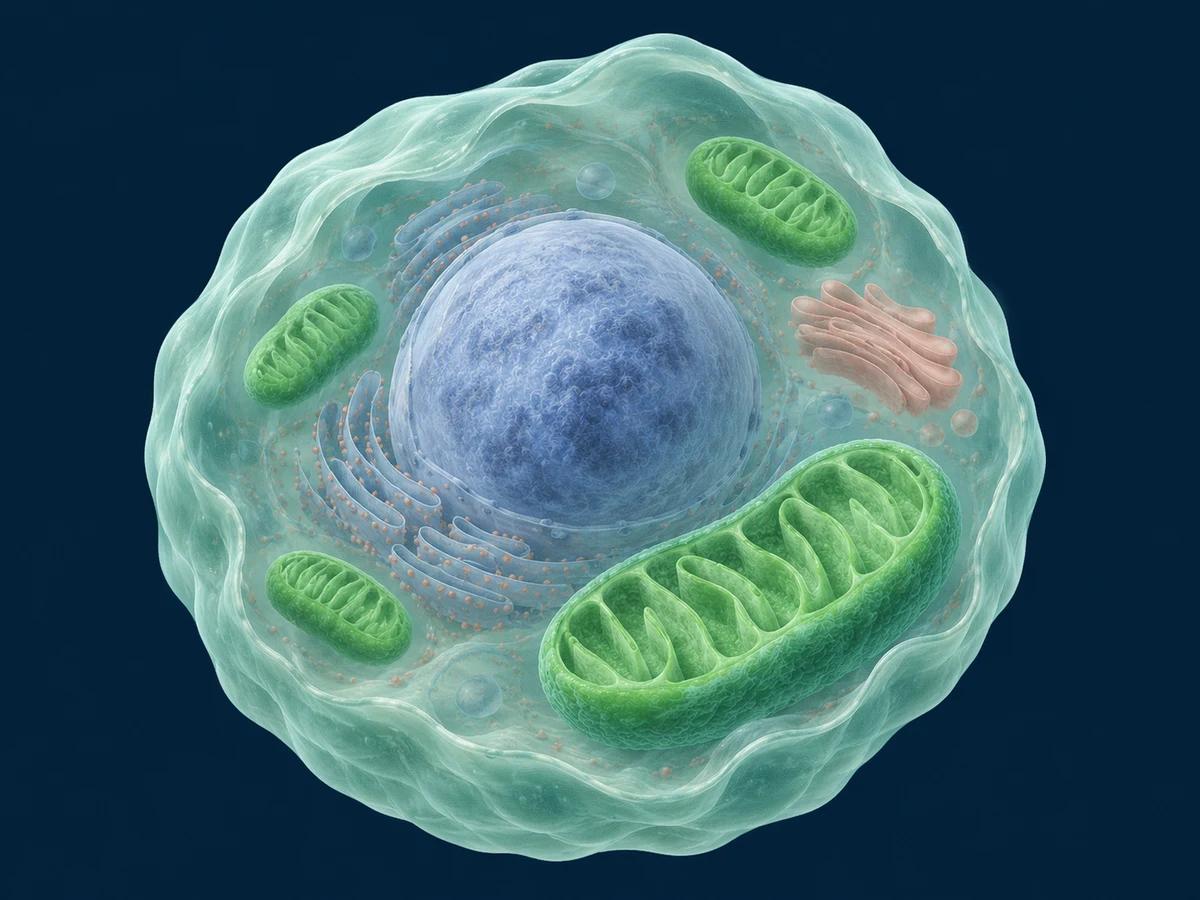
Mitochondria help cells convert fuel into usable energy. They also carry their own DNA and take part in signals between the cell and its surroundings. This biology is one reason researchers study them in chronic disease. [1]
Where energy is made
The folded inner membrane of a mitochondrion helps organize energy production. Mitochondrial DNA and the DNA in the nucleus work together in this process. A 2016 genetics perspective describes how mitochondrial variation and the environment can affect cell function. It is an explanation of biology, not a clinical test of a frequency device. [1]
What happens when DNA escapes
Mitochondrial DNA normally belongs inside mitochondria. In some forms of cellular stress, it can reach the surrounding cytoplasm, where DNA-sensing pathways can respond. The paired illustrations show containment and release as a simplified mechanism, not a before-and-after treatment result. [2][3]
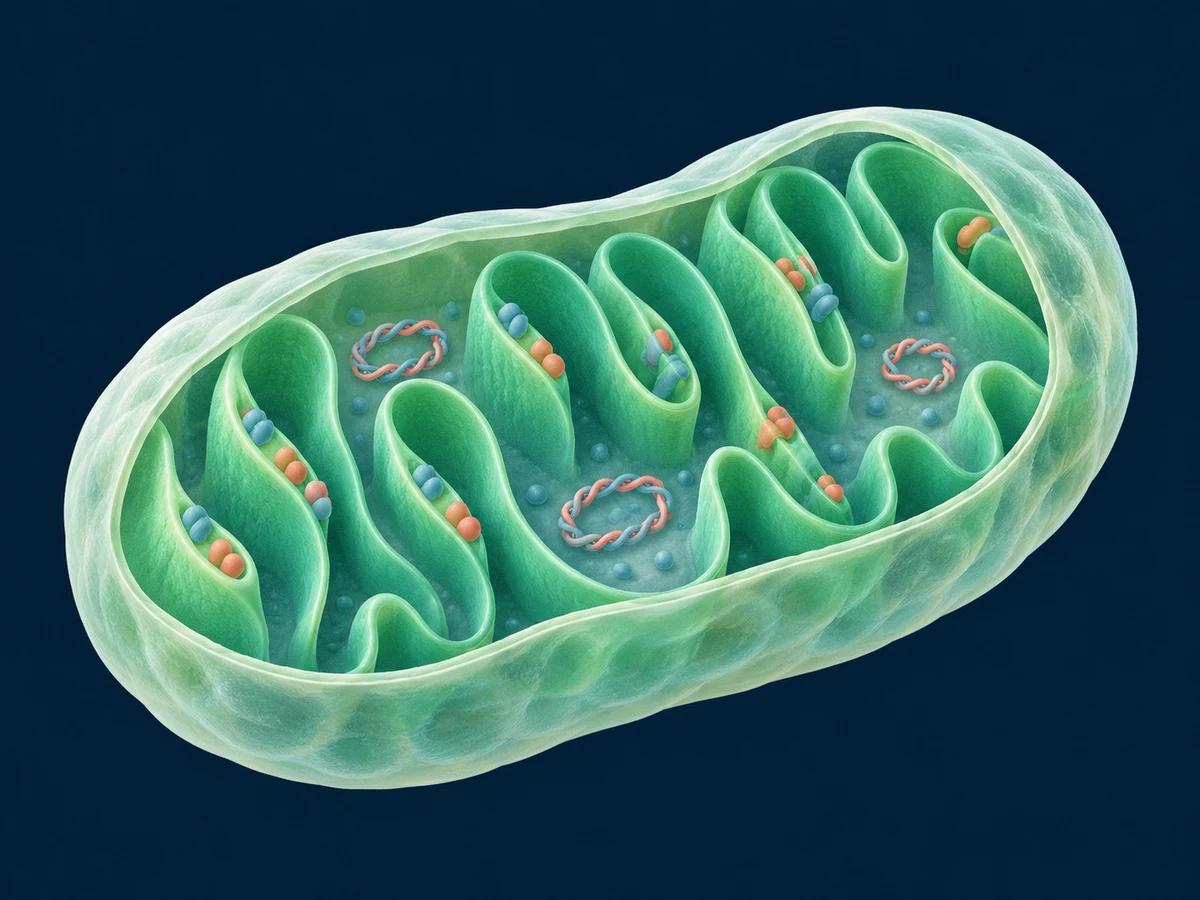
DNA stays inside
An intact mitochondrial boundary keeps DNA in its usual compartment.
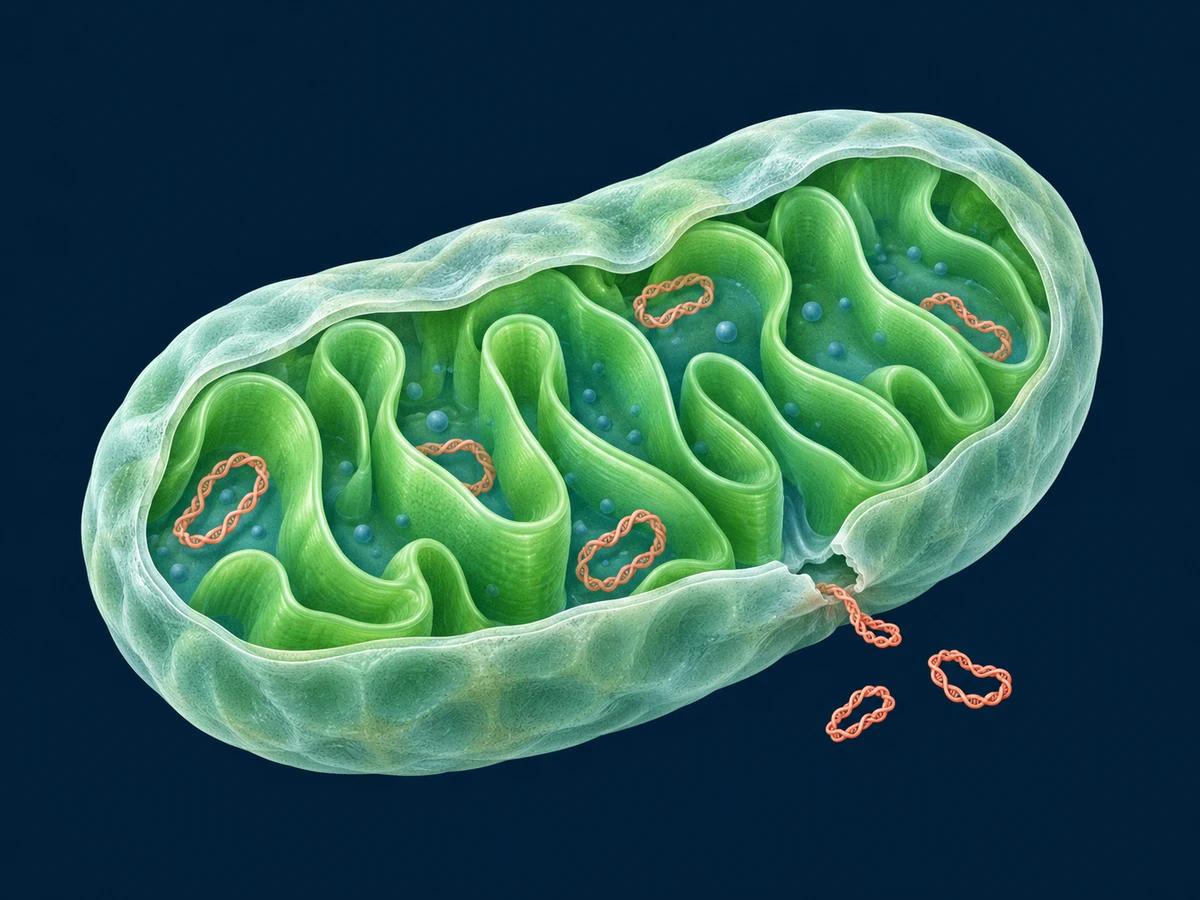
DNA reaches the cytoplasm
In some forms of stress, mitochondrial DNA can escape into the surrounding cell.
How an immune alarm can start.
Researchers are investigating how misplaced DNA can activate immune signaling. This helps explain a possible link between mitochondrial disruption and inflammation. [2][3]
What researchers changed
A 2023 study investigated a TOP1MT gene variant found in a family with early autoimmune disease. In experimental cells with reduced or missing TOP1MT, the researchers observed mitochondrial DNA release and activation of the cGAS-STING signaling pathway. The cell experiments show a possible mechanism; they did not test a clinical frequency treatment. [2]
What the TOP1MT experiment followed
Change TOP1MT
Researchers studied cells with reduced or missing activity of this mitochondrial protein.
Measure DNA release
Mitochondrial DNA appeared in the surrounding cytoplasm.
Measure immune signaling
The cGAS-STING pathway became activated.
How the signal can grow
DNA sensors are part of normal immune defense. A 2021 review describes how cGAS-STING and TLR9 can recognize misplaced self-DNA, and how poorly controlled signaling is involved in autoimmunity. The visual below follows that proposed chain without making it the explanation for every autoimmune condition. [3]
A possible signaling chain
Cellular stress
Some forms of stress can disrupt mitochondrial integrity.
Misplaced DNA
DNA outside its usual compartment can act as a danger signal.
DNA sensors respond
Pathways including cGAS-STING and TLR9 can activate immune signals.
Inflammatory feedback
Poorly controlled signaling can contribute to further tissue stress.
Why patterns can differ.
Research asks two separate questions: how mitochondrial changes affect a cell, and when signs of disease become detectable in people. Different study designs answer each question.
A controlled look at DNA mixtures
In a 2014 laboratory study, researchers made cell lines with different proportions of one mitochondrial DNA variant, 3243A>G. They measured energy-related cell behavior and gene activity. Changes were not simply proportional to the amount of the variant. This was a study of a specific inherited mitochondrial variant, not a universal threshold for autoimmune symptoms. [4]
Change one variable, measure the response
A controlled cell model
Laboratory cell lines with different proportions of the 3243A>G mitochondrial DNA variant.
Measure cell behavior
Researchers assessed energy-related function and gene activity.
Look for transitions
Some responses changed sharply rather than in a simple straight line.
Signs can precede a diagnosis
Researchers examined stored blood samples from 130 people who later received a lupus diagnosis. In 115 people, at least one tested autoantibody was present beforehand: an average of 3.3 years earlier, and up to 9.4 years earlier. This observational study concerns lupus autoantibodies; it does not show that frequency scans detect disease or that a device changes its course. [5]
Blood samples before a lupus diagnosis
had at least one tested autoantibody present before diagnosis.
- 3.3 years
- Average time before diagnosis in those with a positive test.
- Up to 9.4 years
- The earliest detection reported in this group.
Connect biology to the device.
A biological mechanism helps explain a research question. Choosing care also needs studies of the actual device, the people it was tested in, and outcomes that matter in daily life.
What would demonstrate benefit
Look for the named device, its dose or settings, and studies in people with the same condition. A comparison group, ideally including a convincing sham when possible, helps separate a device effect from other reasons people improve. Cell experiments alone cannot answer that clinical question.
From a mechanism to a clinical question
Define the device
Name the equipment, settings, dose, and condition being studied.
Make a fair comparison
Compare outcomes with a suitable control or sham when possible.
Measure daily-life outcomes
Follow symptoms, function, side effects, and duration of any benefit.
Different technologies need different evidence
Light therapy, PEMF, microcurrent, and hyperbaric oxygen use different inputs. Their settings, intended uses, evidence, and safety considerations need to be reviewed individually. NIH describes mixed findings for pain-related magnetic therapies; FDA guidance and safety communications address particular device categories. [6][7][8]
Four inputs, four different questions
Light
Wavelength, dose, target tissue, and evidence for the intended use. Source 7.
PEMF
Changing magnetic fields, specific settings, and condition-specific findings. Source 6.
Microcurrent
The electrical stimulation device, its purpose, and the supporting study.
Hyperbaric oxygen
Oxygen under pressure, the proposed indication, equipment, and trained supervision. Source 8.
Bring the study to your consultation
Ask what was tested, what changed for participants, how long the results were followed, and what remains uncertain. Bring your diagnosis, medicines, and any implanted-device information so the discussion fits your existing medical care.
Read a study through four questions
What was tested?
The exact product, procedure, or device and its settings.
Who took part?
The diagnosis, number of participants, and comparison group.
What changed?
Outcomes people could notice, and how long they were followed.
What is uncertain?
Study limitations, risks, and whether it applies to your situation.
Sources and further reading.
The numbers beside each explanation link to these original papers and public agency sources. Mechanistic papers, observational findings, and device guidance are identified separately.
- 1
Wallace DC. Genetics: Mitochondrial DNA in evolution and disease. Nature. 2016;535:498-500. Genetics perspective.
PubMed 27383787 (opens in a new tab) - 2
Activation of the cGAS-STING innate immune response in cells with deficient mitochondrial topoisomerase TOP1MT. Human Molecular Genetics. 2023;32:2422-2437. Experimental cell study.
PubMed 37129502 (opens in a new tab) - 3
Amadio R, Piperno GM, Benvenuti F. Self-DNA sensing by cGAS-STING and TLR9 in autoimmunity: is the cytoskeleton in control? Frontiers in Immunology. 2021;12:657344. Mechanistic review.
pmc.ncbi.nlm.nih.gov (opens in a new tab) - 4
Picard M, et al. Progressive increase in mtDNA 3243A>G heteroplasmy causes abrupt transcriptional reprogramming. PNAS. 2014;111:E4033-E4042. Controlled laboratory cell study.
PubMed 25192935 (opens in a new tab)
- 5
Arbuckle MR, et al. Development of autoantibodies before the clinical onset of systemic lupus erythematosus. New England Journal of Medicine. 2003;349:1526-1533. Observational study of stored blood samples.
PubMed 14561795 (opens in a new tab) - 6
National Center for Complementary and Integrative Health. Magnets for pain: what you need to know. National Institutes of Health.
www.nccih.nih.gov (opens in a new tab) - 7
U.S. Food and Drug Administration. Photobiomodulation (PBM) devices: premarket notification [510(k)] submissions. Draft guidance for industry and FDA staff, January 2023.
www.fda.gov (opens in a new tab) - 8
U.S. Food and Drug Administration. Follow instructions for safe use of hyperbaric oxygen therapy devices: letter to health care providers. August 25, 2025.
www.fda.gov (opens in a new tab)
Educational illustrations are simplified and not to scale. This page summarizes research and is not individual medical advice. Evidence about cellular mechanisms does not by itself establish a benefit from a particular device. Keep working with the clinicians who manage your care.
Bring your questions.
Tell us what you are considering. We can explain the evaluation process and help you understand the next step.
Prefer to call? (812) 634-1725